

By Krizbella the Grim, Supreme Princess of Disappointment
Supreme Princess of Disappointment and Reluctant Queen of the Forest
I have been tricked.
Not by humans. Not by Jugbite. Not even by one of those suspiciously cheerful board-game designers.
No.
I was tricked by a tree.
Someone handed me Undergrove, a 2024 board game from Elizabeth Hargrave and Mark Wootton, and apparently decided that what my miserable goblin existence was missing was becoming a Douglas-fir tree and developing a business relationship with mushrooms.
Because obviously.
I woke up one morning as a goblin.
Then, somehow, I was a tree.
This is exactly the sort of nonsense I have come to expect from board games.
Apparently, I Am a Tree Now
The basic idea of Undergrove is actually rather lovely.
You are a mature Douglas-fir in the Pacific Northwest.
You have seedlings.
There are mushrooms.
The mushrooms provide nutrients.
You exchange resources with them.
You grow your little tree empire.
It’s all very peaceful.
Disgustingly peaceful.
I prefer games where something explodes.
Instead, Undergrove wants me to appreciate the delicate symbiotic relationship between trees and fungi.
Fine.
Apparently trees and mushrooms cooperate to exchange nutrients and carbon.
Wonderful.
Nature has invented networking.
And somehow I am expected to participate.
The exact focus of this review is the thing I hate most: thinking.
And Krizbella the Grim Undergrove review is unfortunately becoming a story about me discovering that plants can apparently outthink me.
I resent this deeply.
The Mushrooms Are Running the Economy
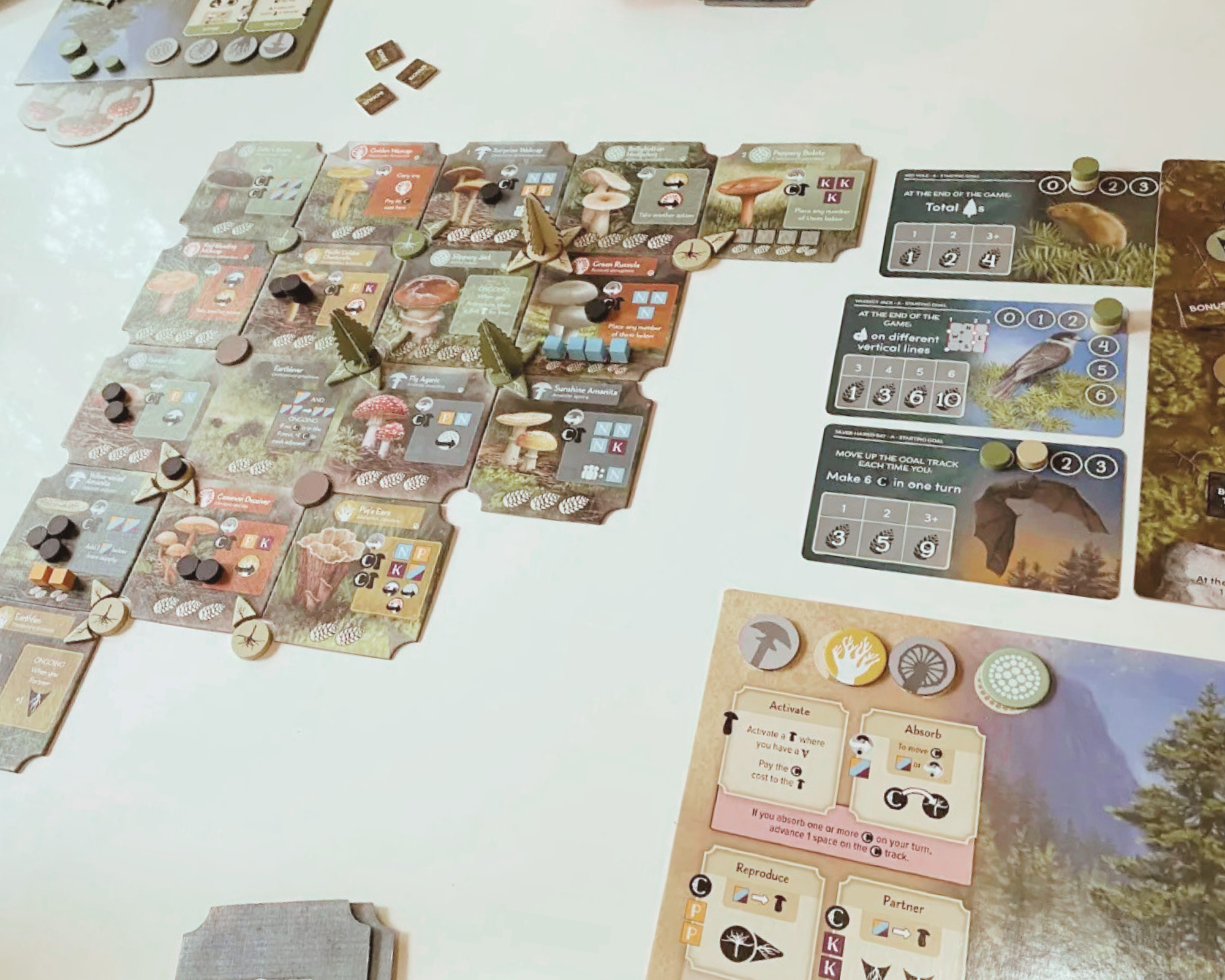
The mushrooms are everywhere.
They sit in the shared forest and offer different opportunities depending on what you connect with them.
You interact with them.
You collect resources.
You convert things.
You build your little network.
And suddenly you’re staring at a forest covered in tiny tiles, cubes and increasingly complicated plans.
I started with:
“I am going to grow some trees.”
Twenty minutes later:
“If I place this here, I can get that nutrient, which lets me do this, which improves that, but only if I have connected the correct mushroom…”
NO.
STOP.
I AM A GOBLIN.
I HAVE STANDARDS.
Very low standards, admittedly.
But standards.
The Forest Belongs to Everyone
One of the things that makes Undergrove interesting is that you’re not building your own completely isolated little forest.
There is a shared forest.
Players are interacting with the same developing landscape, and suddenly placement matters.
That mushroom you were casually ignoring?
Someone else wants it.
That wonderful little space you were planning to use?
Gone.
Because another player has apparently decided that your happiness is not part of their strategy.
Finally.
A tiny glimpse of civilization.
I knew this game had some goblin potential.
Mushroom Friendship Is Apparently a Weapon
The mushrooms aren’t just decorative little fungal potatoes.
They matter.
Different mushrooms give you different opportunities, and figuring out which relationships are useful becomes a big part of the game.
This creates combinations.
Lots of combinations.
Far too many combinations.
At first you’re simply placing things.
Then you notice that one decision helps another.
That decision helps something else.
Suddenly you have built a tiny woodland machine.
And now you are emotionally attached to a mushroom.
I hate this development.
I especially hate it because it works.
The Tiny Cubes of Doom
There are resources.
There are conversions.
There are tracks.
There are little cubes that apparently have the power to turn a perfectly pleasant afternoon into a strategic crisis.
You move things around.
You trade things.
You use things.
You get things.
Then you realize you needed the thing you just used.
Excellent.
Wonderful.
A flawless system designed specifically to make me mutter at cardboard.
Undergrove doesn’t necessarily feel brutally complicated.
Instead, it gives you just enough information to make you think you understand what you’re doing.
Then you notice another possibility.
Then another.
Then another.
And now your brain is filing a formal complaint.
Growing Seedlings Is Surprisingly Stressful
The actual goal is charming.
You establish seedlings and help them grow throughout the forest.
You want them in useful places.
You want connections.
You want your forest to develop efficiently.
You want your choices to generate useful combinations.
This sounds relaxing.
It isn’t.
Because every time I placed something, I immediately saw somewhere else I probably should have placed it.
Board games love doing this.
They show you the consequences of your mistakes approximately seven seconds after you’ve made them.
Very considerate.
And Then There Are the Goals
Because apparently growing a tree wasn’t enough.
There are goals.
There are things you can aim for during the game that encourage particular strategies or scoring opportunities.
So now I have my forest.
My mushrooms.
My resources.
My seedlings.
My various strategic concerns.
And a little voice in my head screaming:
“YOU SHOULD HAVE BEEN DOING THAT THREE TURNS AGO.”
That voice is Jugbite.
He is not invited back.
The Carbon Track Is Watching Me
There is also a carbon element running through the game.
Because apparently even my imaginary tree needs to worry about carbon management.
The carbon track can provide bonuses and points, giving you yet another thing to keep an eye on as your forest develops.
I stared at it.
It stared back.
Neither of us blinked.
Eventually I moved a cube.
This is apparently entertainment now.
The Worst Part: The Combos
Here is where Undergrove gets me.
The combos.
I hate combos.
Not because they’re bad.
Because they’re good.
You see a possibility.
You try it.
It works.
Then you realize another action can build on it.
So you try that.
Suddenly you’ve had a productive turn.
You feel clever.
You feel powerful.
You feel like perhaps you have finally understood the forest.
Then your turn ends.
And someone else does something even better.
I hate board games.
The Forest Is Peaceful Until It Isn’t
Visually, Undergrove looks wonderfully calm.
Mushrooms.
Trees.
Seedlings.
Nature.
Beautiful woodland artwork.
It practically whispers:
“Relax.”
LIAR.
Underneath all that peaceful woodland nonsense is a game asking you to think several steps ahead.
The forest may be tranquil.
My brain is not.
That is an important distinction.
Jugbite Becomes a Botanist
Jugbite decided he understood the game immediately.
This was his first mistake.
He began explaining mushrooms to me.
To me.
He started pointing at things.
“This one gives you—”
“I KNOW.”
“And if you connect—”
“I SAID I KNOW.”
“And then you can—”
I threw a mushroom token at him.
It bounced off his hat.
He continued explaining.
This is why goblins need separate gaming tables.
Is Undergrove Too Complicated?
No.
Not really.
But it looks more complicated than it feels.
Once you understand the basic flow, the game starts to click.
The challenge comes from seeing opportunities and making your forest work efficiently.
There is strategy.
There is planning.
There is competition over useful spaces.
There are combinations.
And there is enough going on that you can spend a turn staring at your options like a goblin who has just been asked to solve an accounting problem.
Which, technically, I am.
The Artwork Is Rude
I must also discuss the artwork.
Because it is beautiful.
And I don’t appreciate it.
Beth Sobel’s artwork makes the forest look inviting, detailed and wonderfully organic.
The mushrooms look like mushrooms.
The seedlings look like seedlings.
The whole thing has a lovely natural atmosphere.
It is almost offensively wholesome.
I wanted dark forests.
I got educational woodland elegance.
Disgusting.
I hate when a board game looks this good while simultaneously forcing me to think.
Pick a struggle.
The Solo Goblin Emerges
There is also a solo mode.
Naturally.
Because sometimes you don’t want to share your woodland suffering with other people.
Sometimes you want to sit alone, surround yourself with mushrooms and silently judge your own decisions.
Finally.
A mode designed for me.
The solo experience gives Undergrove some extra longevity and makes the game appealing even when your fellow goblins have mysteriously disappeared.
Or when you have driven them away.
Which is usually my preferred method.
Why I Actually Like Undergrove
Here is the part where I become extremely uncomfortable.
I like it.
There.
I said it.
I hate that I said it.
Undergrove takes a fascinating natural relationship and turns it into a strategic game about developing a forest, managing resources, connecting with mushrooms and finding increasingly clever combinations.
It isn’t simply about putting trees on a board.
There is a satisfying puzzle underneath everything.
Every decision can open another possibility.
Every mushroom can change what you’re able to do.
Every seedling can become part of a larger plan.
And when everything clicks?
It feels really good.
I hate that.
But Is It Fun?
Yes.
Unfortunately.
It is relaxing in the same way that reorganizing your entire cupboard at midnight can be relaxing.
You start with one little task.
Then another.
Then suddenly you’ve spent an hour optimizing something nobody asked you to optimize.
That’s Undergrove.
Except instead of organizing cans, you’re building a forest.
And instead of questioning your life choices, you’re questioning your mushroom placement.
Same energy.
My Rotten Verdict
Krizbella the Grim Undergrove review has reached the point where I must admit something deeply humiliating.
This is a good game.
A very good game.
It is clever without being completely overwhelming.
It has an interesting theme.
The mushroom and tree relationship is unusual.
The shared forest creates interaction.
The combinations are satisfying.
The artwork is gorgeous.
And the strategic puzzle keeps unfolding as you play.
I still object to the entire concept.
I object to being a tree.
I object to mushrooms being strategically important.
I object to carbon tracks.
I object to cubes.
I especially object to Jugbite explaining fungi to me.
But somehow…
I want to play it again.
This is unacceptable.
Final Score from Krizbella the Grim
🌲🍄 4 out of 5 Goblin Sneers
Undergrove is a clever, beautiful woodland strategy game that somehow convinced me that managing mushrooms and growing seedlings could be fun.
I resent it.
I resent the mushrooms.
I resent the trees.
I resent the cubes.
I resent the carbon.
I resent Jugbite.
Most importantly, I resent the fact that I am already thinking about what I would do differently next game.
Now get out of my forest before I plant you.
— Krizbella the Grim, Supreme Princess of Disappointment 👑
 Jugbite