


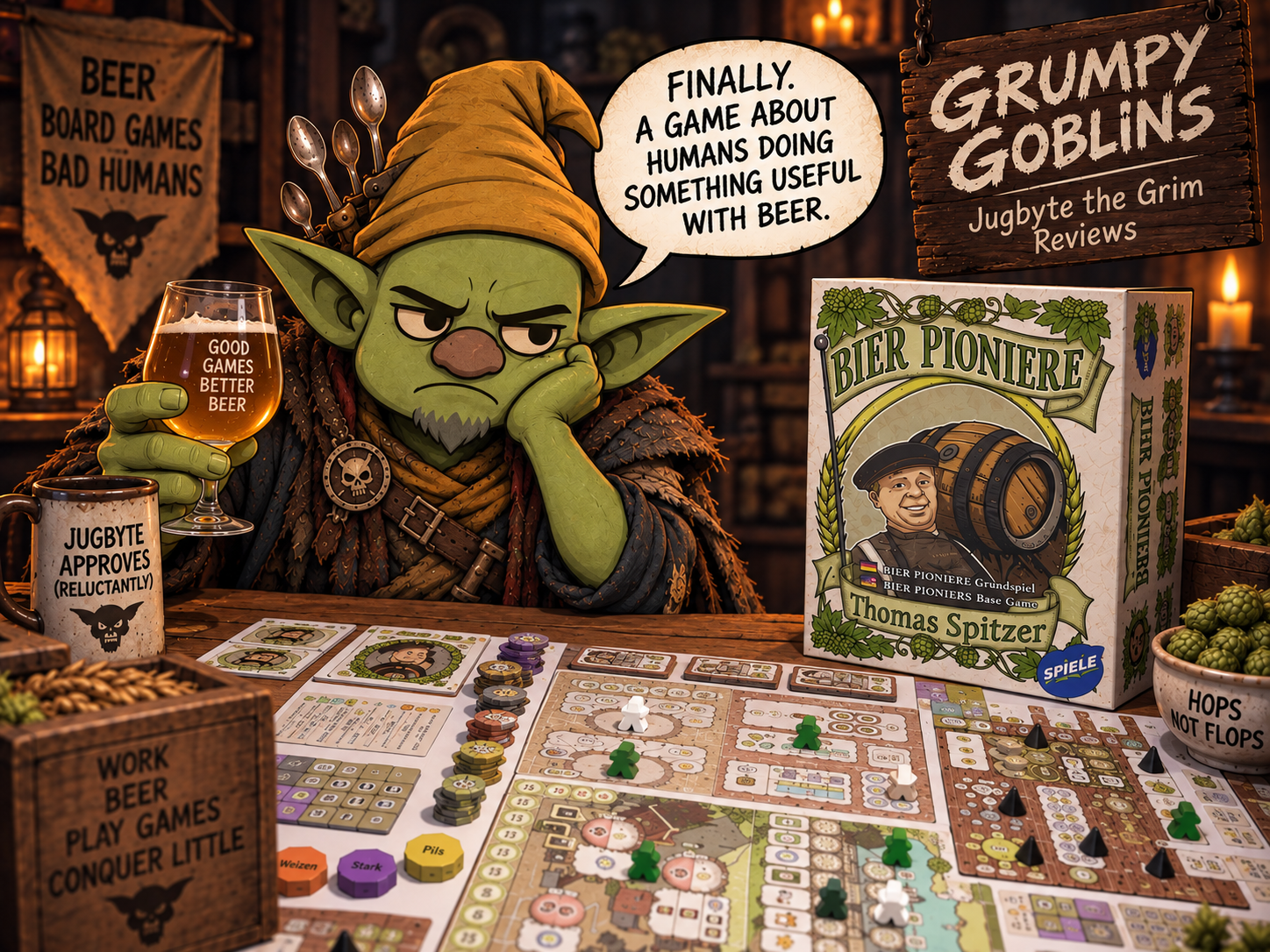
Humans have finally done something sensible: they built a game about beer.
Unfortunately, they also built a game about worker placement, brewing efficiency, card management, turn order, barrel logistics, brewery expansion, objectives, worker experience, brewing levels and approximately seventeen different ways to make Jugbite stare into the middle distance.
This is Bier Pioniere, designed by Thomas Spitzer and published by Spielefaible. It puts you in charge of a small brewery around 1850 and asks you to turn the miserable little operation into a proper industrial beer factory. The game supports 2-4 players and runs roughly 75-100 minutes according to BoardGameGeek.
And yes, humans.
For once, they may have built something worth drinking near.
Build the brewery, then make the beer actually work
At first, your brewery is pathetic.
You can only brew Alt, most of your brewery is blocked, and your workers are inexperienced little problems with legs. The rules begin with five of your six beer coops blocked by tokens and cover tiles, while your brewing level limits how many beer types you can brew.
So you improve.
You remove blocking tokens. Expand the brewery. Improve your brewing process. Upgrade workers. Add extensions. Build up your card display. Acquire barrels. Move barrels into the cellar. Brew beer. Deliver beer.
Then discover that the beer you desperately need is sitting on a card you cannot currently access.
Excellent.
Now that is a board game.
The clever part is that almost everything feeds something else. Improving brewery progress reduces brewing time. It also unlocks bonuses such as increased income, a larger hand limit and a victory point. Meanwhile, your brewing level determines both how many beer types you can brew and which cards in the shared display are available to you.
This creates the kind of development curve I actually like. You are not simply collecting points. You are gradually making your brewery more capable of doing the things you already wanted to do.
Workers with experience. Finally, useful employees.
The main action system is worker placement, but your workers have experience levels.
You start with workers at experience 1 and 2. Put a worker on an action space whose experience value combines with the worker’s experience to reach at least 6, and congratulations, your employee has apparently achieved enough professional development to unlock a bonus action.
This is one of the game’s best ideas.
It makes worker placement more than simply “I put meeple here because this spot does thing.”
You are considering which worker to use, which action space to occupy, and whether that placement will also trigger something extra. Later, workers can be upgraded, with retired workers opening additional cellar space and providing bonuses.
Even the turn order becomes part of the puzzle because choosing your position for the next round can give you access to bonuses, including the neutral worker or truck that provides additional actions.
That is good design.
Annoyingly good.
The cards are doing far too much, which is exactly why they work
The action cards are particularly nasty little things.
Each card has three possible functions. The beige-brown section can become part of your permanent display and improve things such as barrels and brewing rotations. Purple cards are beer delivery contracts. White cards provide special actions or can become permanent master brewer characters.
So the card you are holding is never simply “a card.”
It is a future engine component.
Or a delivery.
Or a useful special action.
Or something you desperately want now but probably should save for later.
Humans do enjoy making decisions unnecessarily difficult.
The six-card display is tied directly to your brewing level, too. As your brewery develops, more of the display becomes accessible.
That creates a satisfying relationship between your personal development and the public card market.
And then there is the beer
Brewing itself is a delayed process. You place brewing dials into available coops, and the required number of rotations depends on the beer and your brewery progress. Beer eventually reaches zero and moves into your cellar.
This means you cannot simply decide:
“I need Weizen.”
Then immediately have Weizen.
No.
You need the right coop. You need access to the beer type. You need brewing capacity. You need rotations. You need cellar space.
And then, assuming the beer survives the bureaucratic nightmare, you can use it for deliveries.
Those deliveries are where the points start coming in properly. Purple contract cards specify the beer and barrels required, with many providing victory points and additional rewards.
It gives the whole game a nice production-chain feeling without reducing everything to a spreadsheet.
My biggest complaint
The problem is obvious.
There is a lot going on.
The rulebook is 32 pages long, and that is not because someone needed more room to draw pictures of beer.
The game has worker placement, multi-use cards, brewing timers, player order, objectives, extensions, blocking tokens, cellar management, upgrades, bonus workers, trucks, income and several overlapping development tracks. The rules are organised, but the game is undeniably substantial.
This is not the game I would put in front of someone who thinks “worker placement” sounds like something you do at a furniture warehouse.
There is also plenty of opportunity for analysis paralysis. When every action can affect another system, the temptation to stare at the brewery board for twelve minutes while everyone else ages into dust is very real.
Krizbella would probably call this “a perfectly organised disaster.”
For once, I would not entirely disagree.
The thing I reluctantly like most
The game understands progression.
Your brewery genuinely becomes better.
You start with one beer type and a miserable collection of blocked spaces. Over time, you improve brewing efficiency, unlock beer types, expand your brewery, improve workers, develop your card engine and gain access to stronger actions. The six extension types each provide different effects, including beer filters, truck fleets, cooling systems, laboratories, malt factories and machine halls.
And the endgame rewards that development rather than simply checking who collected the most points along the way. Once someone reaches 20 victory points, the round finishes and additional scoring comes from lightbulbs and, for players who reached the final brewing-level space, coins spent on those lightbulbs.
That is a proper arc.
Small brewery.
Big brewery.
More beer.
More machinery.
More points.
More headaches.
Excellent.
Final Verdict
Bier Pioniere looks like the sort of game humans designed after deciding that making beer was not complicated enough.
And somehow, it works.
There is a lot to learn, plenty of interconnected systems to manage, and enough strategic development to keep the game interesting beyond simply completing orders for points. The worker experience system, multi-use cards, brewing progression and brewery development all reinforce the central idea rather than sitting beside the theme wearing a fake moustache.
The price of entry is complexity. This is a game for players who enjoy having several things to worry about at once.
If that sounds appealing, Bier Pioniere deserves serious attention.
If not, well…
There are always lighter games.
I assume Krizbella has already thrown them into the swamp.
Jugbite’s Rating: 8.5 cabbages out of 10.
A surprisingly sophisticated brewery engine with meaningful development, clever worker placement and enough interconnected systems to keep a goblin busy. Disgustingly competent.
 Krizbella
I see Jugbite has discovered industrialization. Took him long enough. Apparently turning grain, water and hops into beer requires approximately 47 interconnected systems, three workers, six beer types and enough cardboard to bury a small goblin.
Still, I have to admit the brewery progression is annoyingly sensible. Humans occasionally manage to build a game where all the little systems actually talk to each other instead of requiring twelve expansions and an app to remember what happened.
Don’t let this go to your head, Jugbite. I said sensible, not good. I have standards.