

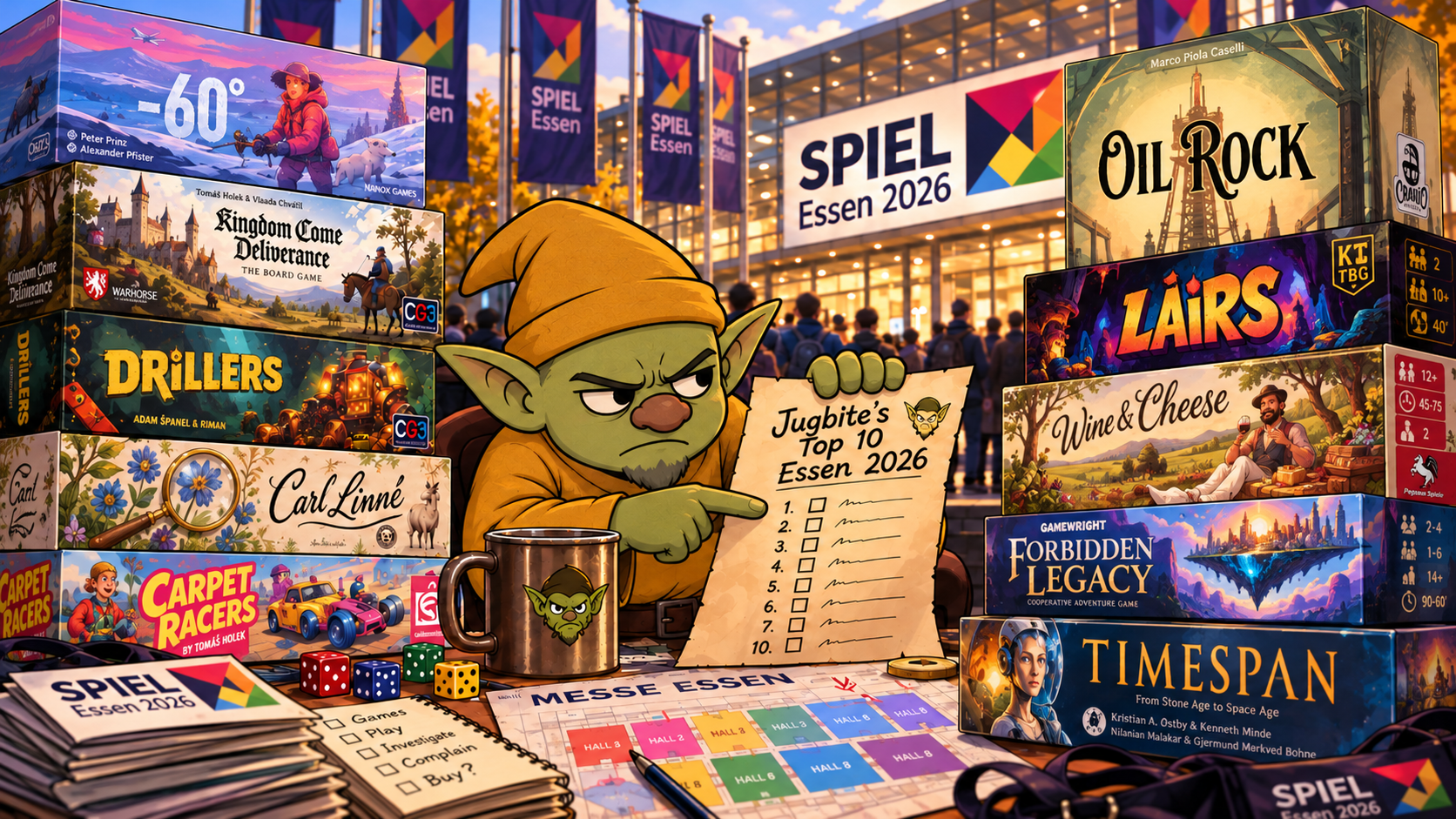
Humans are gathering again for their annual pilgrimage to Essen, where thousands of you will willingly enter eight enormous halls packed with cardboard, plastic, questionable purchasing decisions and enough new games to bankrupt a small goblin kingdom.
Yes, Essen SPIEL 2026 is almost upon us. From October 22 to 25, the Messe Essen will once again be invaded by people searching for their next great board game while carrying bags that become progressively heavier and wallets that become progressively emptier. The fair is using all eight exhibition halls this year, because apparently seven halls of cardboard were not enough for your species.
I have been digging through the new releases, and despite my better judgment, I have found ten games that have managed to catch my attention. Some look clever. Some look ambitious. One involves oil, because apparently we still have not learned anything. And one is about cheese and wine, which is probably the most sensible use of cardboard I have seen all year.
Here are the ten games I will be watching at SPIEL Essen 2026.
1. -60° (Sixty Below)
Antarctica. Meteorites. Research stations. Freezing temperatures. Limited resources. Finally, a game where the weather is more hostile than my opinion of most modern rulebooks.
-60° puts players in an alternate 1971, leading research teams across the Antarctic wilderness toward a mysterious meteorite impact site. Players build networks of stations, explore the frozen landscape, manage scarce resources and develop scientific projects while trying to reach the meteorite first.
It has exploration, worker placement and resource management, but what really catches my attention is the combination of harsh environmental conditions and long-term expedition planning. This looks like the sort of game where one stupid decision several turns earlier eventually comes back to bite you in the frozen backside.
Good. That sounds familiar.
2. Kingdom Come: Deliverance – The Board Game
Take a historically grounded medieval RPG, give it to Tomáš Holek and Vlaada Chvátil, turn it into a giant board game and charge humans €149.99 for the privilege of carrying it home.
Obviously I am interested.
Kingdom Come: Deliverance – The Board Game combines an epic adventure with eurogame elements and deck-building. Players begin as ordinary peasants in 15th-century Bohemia and develop their characters through different paths, including combat, alchemy, archery, persuasion and thievery. The game supports 1–4 players and is designed to run at roughly 90 minutes per player.
CGE is bringing the game to the Essen 2026 launch window, with its first pre-order wave scheduled around SPIEL. A second pre-order wave is already planned for 2027. Which means some humans will apparently be standing in queues to collect a very large medieval cardboard problem they were perfectly capable of ordering from a computer.
I understand completely.
3. Drillers
Mechs. Mines. Minerals. Deck-building. Running out of fuel while deep underground.
Yes.
Drillers has my attention.
You take a drilling mech into an abandoned mine, excavate valuable minerals and try to make it back to the surface before your resources become a particularly expensive funeral. The cards are multi-use, you upgrade your deck and mech, and your decisions can affect the opportunities available to other players. It supports 1–4 players and is designed around roughly 30 minutes per player.
The important part is that going deeper gives you better opportunities while also making the return trip more dangerous. That is the sort of push-your-luck decision I like. Humans always want to go deeper. Humans rarely consider the trip back.
Perhaps this is why you keep losing things in basements.
4. Carl von Linné
Natural science, exploration, specimens, botanical gardens and the historical development of taxonomy.
Somewhere, a Swedish goblin just sat up straighter.
Carl von Linné places players in the early 18th century as natural historians inspired by Carl Linnaeus and his contemporaries. Players explore distant regions, collect and research specimens, cultivate botanical gardens, correspond with scientific institutions and publish books while building knowledge and reputation. A lens system helps determine how players balance fieldwork and scholarly study.
It is an unusually specific theme, which is exactly why I want to see it. Essen does not need another game where somebody is building a generic medieval kingdom and calling it innovation. Give me taxonomy. Give me specimens. Give me miserable scientific arguments over where a plant belongs.
Now that sounds like civilization.
5. Carpet Racers
This one sounds ridiculous.
Which is precisely why it has made the list.
Carpet Racers is a racing game for 3–5 players where nobody initially knows which car is actually theirs. Players move cars, set traps, gather clues and try to work out their own secret identity while simultaneously attempting to win the race. It combines racing, bluffing and deduction in a game lasting roughly 25–45 minutes.
So instead of simply racing your own car, you are racing several cars while trying to figure out which one you are supposed to care about.
Excellent. A racing game with an identity crisis. Humans have finally made a game about modern life.
6. Oil Rock
Nothing says peaceful Thursday evening like building an oil empire.
Oil Rock puts players in control of expanding oil companies competing for influence and efficiency. You will position yourself on an action wheel, expand across the map, build drilling rigs, develop refineries and turbines, manage railway connections and improve your company while trying to dominate the market. It is a 2–4 player strategy game with an advertised play time of around 50-80 minutes.
It is also an interactive design, with worker placement on the wheel and development both on personal boards and the shared map.
I have no idea whether building an oil empire is morally questionable in this particular cardboard universe. I do know that if there is a mechanic where somebody can ruin my carefully planned supply chain because they placed a worker in the wrong place, I will probably enjoy it.
That is what board games are for.
7. Lairs
Build a dungeon. Fill it with walls, traps, treasures and monsters. Then hand it to your opponent and try to survive theirs.
Lairs is a two-player deduction game in which both players construct a dangerous catacomb for the other player to explore while simultaneously attempting to navigate the opponent’s creation themselves. The game is designed for roughly 35 minutes and mixes deduction, exploration and a little luck.
This is exactly the sort of compact idea I like seeing at Essen. You are not merely solving somebody else’s puzzle. You are building the puzzle they have to solve while secretly hoping you were more clever than they were.
Petty. Competitive. Efficient.
Very goblin.
8. Wine & Cheese
Wine and cheese.
Finally, a game about something humans actually understand.
Wine & Cheese is a two-player strategic game set in Burgundy where players manage farms producing both wine and cheese. Ingredients are gathered using paired workers, production and ageing need to be timed carefully, and players must balance the two products because at the end of the game the weaker of the two income streams determines the reward.
It is the spiritual successor to Beer & Bread, but the designers explicitly describe it as more complex with different mechanics rather than simply putting a new label on the old machine.
I appreciate that. Humans have enough games that are essentially the same mechanism wearing a different hat.
Wine and cheese, however, is a combination I am willing to investigate thoroughly.
9. Forbidden Legacy
Forbidden Legacy takes the familiar Forbidden formula and turns it into a seven-episode adventure involving a crumbling city floating above Earth, time travel, hidden components and lasting changes to the game.
Players must repair a portal and keep the city afloat while working through a campaign in which new rules, abilities and challenges emerge over time. It supports 2–4 players and is designed for roughly 30–60 minutes per episode.
I am particularly interested in the legacy element. The best campaign games make your decisions matter without turning the first thing you do into a permanent punishment because you misunderstood one sentence on page seventeen of the rulebook.
If Forbidden Legacy can deliver meaningful evolution without drowning the experience in campaign administration, it deserves attention.
Also, a city floating above Earth while everything is collapsing sounds like an appropriate metaphor for Essen on Saturday afternoon.
10. Timespan
Lead a civilization from the Stone Age to the Space Age in about 90 minutes.
Apparently humanity has finally invented fast-forward.
Timespan is a civilization game for 1–5 players where each player chooses from asymmetric civilizations and combines that choice with one of several technology boards. Players can further customize their civilization by recruiting from a large selection of historical people, buildings, technologies and wonders. Much of the game is played simultaneously, with five rounds covering exploration and action phases.
There is no warfare. Instead, the focus is on peaceful civilization building, exploration and developing an economic engine. That alone makes it unusual enough to get my attention. Humans have somehow managed to make a civilization game where you can reach the space age without immediately declaring war on somebody.
Perhaps there is hope for you after all.
So, What Am I Actually Looking Forward To?
There are hundreds of games competing for attention at SPIEL Essen 2026, and I have no intention of pretending these ten are objectively the ten best games at the fair. That would be nonsense. They are the ten that currently have me most interested in finding a table, stealing a chair and forcing some unfortunate human to explain the rules to me.
-60° has the exploration and survival puzzle. Kingdom Come: Deliverance is an enormous project with some very serious names behind it. Drillers looks like the sort of risk-management headache I enjoy. Carl von Linné has a theme I genuinely want to see handled well. Carpet Racers sounds gloriously stupid in exactly the right way.
Then there is Oil Rock, Lairs, Wine & Cheese, Forbidden Legacy and Timespan, all offering very different reasons to stop wandering around Essen long enough to actually sit down and play something.
Essen SPIEL 2026 runs from October 22 to 25. The doors open at 10:00 each day, with Sunday ending at 18:00. The fair is spread across all eight halls of Messe Essen this year, so if you intend to play everything you want, I recommend bringing sensible shoes, water and the sort of determination normally reserved for military campaigns.
As for me, I will be looking for good games.
If I find them, I will grudgingly admit it.
If I find bad games, I will remember them.
And if I find a shiny ceramic mug at a reasonable price, the rest of the expedition is cancelled.
Now tell me, humans: which games are you hunting for at SPIEL Essen 2026?
 Krizbella