
By Krizbella the Grim, Supreme Princess of Disappointment
FOMO is a particular kind of human stupidity that becomes especially impressive when cardboard is involved.
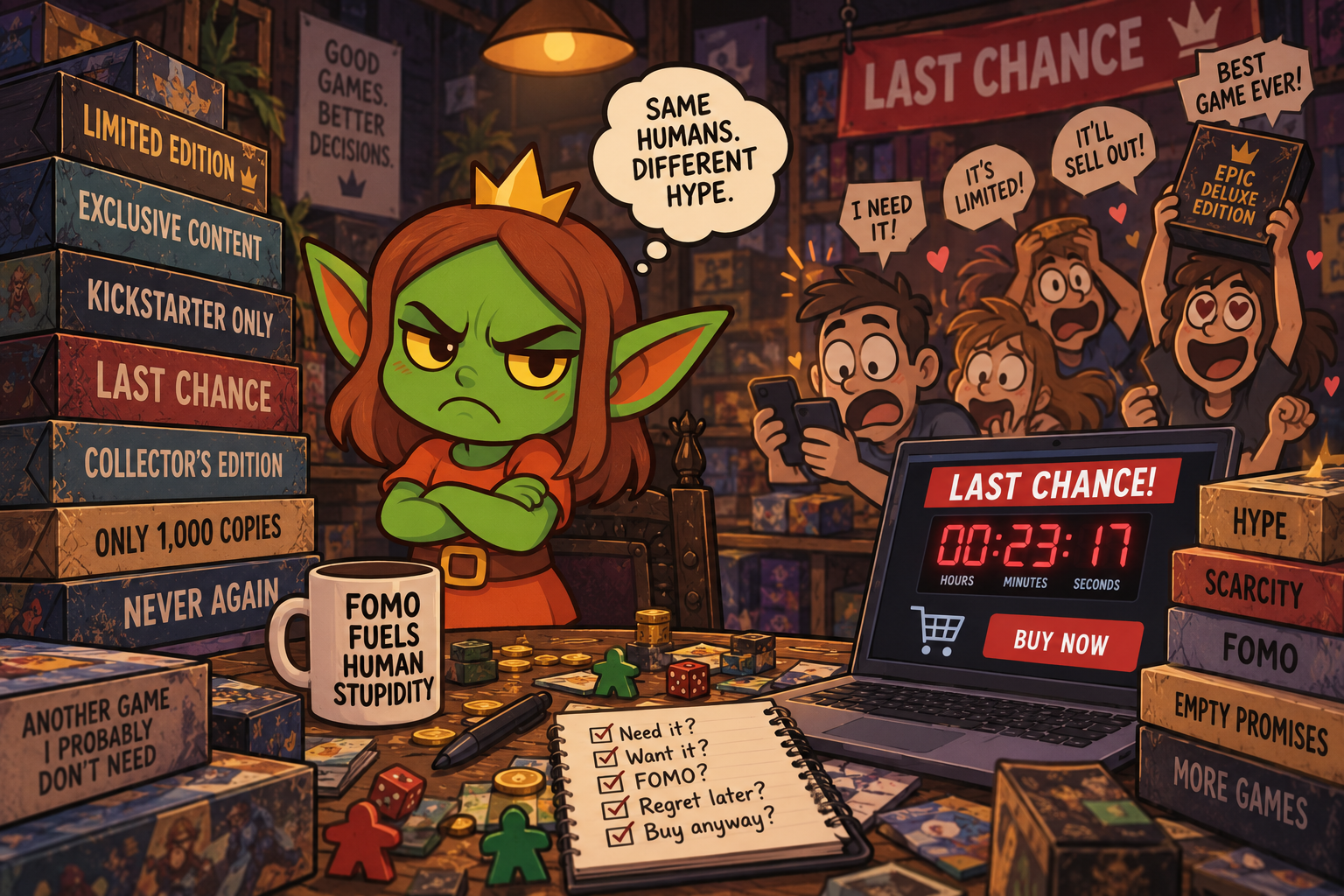
It can turn perfectly ordinary adults into frantic little purchasing machines the moment somebody puts the words “limited,” “exclusive,” or “last chance” next to a board game.
I have watched this nonsense happen far too many times.
You look at a game, decide you are not particularly interested, and continue living your life like a functioning creature. Then someone announces that there are only a certain number of copies, or that some tiny cardboard token will never be available again.
Suddenly, your magnificent human brain acts as though your entire bloodline depends on getting that box before Tuesday.
You check the campaign page again. Then you read comments from strangers, compare photographs, calculate shipping and taxes, and start wondering whether you might regret not buying it.
Never mind that you apparently did not want the bloody thing badly enough to buy it until someone suggested that you might not be able to get it later.
That is the part I find so wonderfully pathetic.
The game has not improved. The rules have not suddenly become cleverer because a clock appeared beside them. The cardboard has certainly not developed magical properties because somebody wrote “exclusive” underneath a picture.
Yet the closer the deadline gets, the more important the game becomes in your head.
You have stopped asking whether you actually want it. Now you are worrying about whether you can tolerate not owning it.
A goblin sees something shiny, decides he wants it and considers whether it is worth the coins. Humans need another human to point at the shiny thing and announce that it might disappear before you can even decide whether you wanted it.
And naturally, you will insist that this is not panic.
Humans Have Very Respectable Names for Panic
Humans are remarkably talented at giving embarrassing behaviour respectable names.
You call it enthusiasm. You call it being an informed buyer. You call it supporting a publisher or securing an opportunity.
Apparently, the one thing you will not call it is what it actually looks like when I watch you frantically refreshing a campaign page because somebody told you there might not be another chance to buy a board game.
The countdown makes everything worse because humans seem to have an almost religious faith in numbers becoming smaller.
Give you thirty days and you shrug.
Give you thirty hours and suddenly the matter requires urgent attention.
Give you thirty minutes and you are apparently prepared to negotiate with your bank account, your partner and several ancient gods to secure a box containing cardboard, wooden pieces and seventeen exclusive plastic objects you had never heard of that morning.
You were perfectly capable of living without the game yesterday. You would have continued living without it tomorrow.
But now there is a timer, and somehow that timer has become more important than your own opinion.
I find that deeply insulting to the concept of having a brain.
If you want to see how often humans create unnecessary drama around perfectly normal board games, you can also take a look at my previous rant, “Why Are Humans Like This?”. Apparently I had not yet complained enough.
When FOMO Makes Humans So Easy to Sell To
The word “exclusive” makes it even worse.
Humans see something that will not be available to everyone and immediately decide that this makes it more valuable. Apparently, rarity improves design now.
A normal component becomes an exclusive component. A normal edition becomes a special edition. Suddenly you are staring at a pile of plastic as though it contains the secrets of the universe.
You are no longer simply buying the game.
You are buying protection against the horrible future in which somebody else owns something you do not.
That is where your precious FOMO really shows its ugly little face.
You scroll through social media and see somebody else with the game. Then another person posts it. Then another.
People are excited, so you become excited. People are buying it, so you start wondering whether you should buy it too.
Someone says the campaign is doing well. Someone else says the game may become difficult to find.
Suddenly, your own opinion has been replaced by a collection of noises made by strangers on the internet.
I have watched humans do this with such enthusiasm that I sometimes wonder whether independent thought is simply an optional expansion for your species.
The Shelf Is Already Full
The most ridiculous part is that your shelves are already full.
They are groaning under the weight of games you absolutely had to have.
There are boxes you bought because everyone was talking about them. There are games you bought because they were on sale. And there are games you bought because you were certain they would become favourites.
There are also the games you bought because you were afraid they would become difficult to find.
Some have been played twice.
Some have never been opened.
Others are sitting in shrink wrap while you stare lovingly at photographs of yet another game you absolutely must own before the timer reaches zero.
Then you buy it.
Naturally, the moment the money leaves your account, the Great Rationalisation begins.
Admitting that you panicked would require a level of honesty that seems to become remarkably scarce whenever limited cardboard is involved.
Suddenly, the purchase was carefully considered.
You will play it eventually. It was a good price. The exclusive content might be difficult to obtain later. You could always sell it. You would have regretted missing it. You needed to make the decision now.
Your brain, having just thrown itself out of the window, climbs back inside wearing a little suit and starts explaining why everything was perfectly sensible.
I have seen this performance often enough to know how it ends.
The game eventually sits on your shelf beside the other games you were terrified of missing.
You continue defending the purchase because admitting that FOMO got you would mean admitting that you were not actually afraid of losing the game.
You were afraid of being the human who did not have it.
That is a much uglier truth, and I suspect that is precisely why you prefer all the elaborate explanations.
FOMO Turns Other People Into Your Shopping List
Humans spend an astonishing amount of time congratulating themselves on being rational creatures.
You build universities, legal systems, financial markets and machines capable of doing calculations that make my head hurt.
Yet put a red banner saying “LAST CHANCE” next to a board game and suddenly all that magnificent civilisation starts trembling.
A goblin at least has the decency to understand when he is being greedy.
You will spend an hour explaining why you absolutely needed something you had no interest in yesterday, then congratulate yourself for making a rational purchasing decision.
It is almost admirable, if you ignore the part where it is completely ridiculous.
Of course, sometimes a game genuinely is limited.
Sometimes an exclusive item really will be difficult to obtain later. Sometimes you have wanted the game from the beginning and the deadline simply forces you to stop procrastinating.
I am not so stupid that I cannot tell the difference between genuine desire and FOMO.
Humans simply have a remarkable talent for making the distinction harder than it needs to be.
If you wanted the game before you knew it was limited, fine.
Buy it. Play it. Enjoy it.
I have no interest in policing perfectly ordinary desire.
But if you did not want it, did not need it, had not even been thinking about it and suddenly became desperate because another human told you that your opportunity was disappearing, then you have allowed somebody else to make the decision for you.
You have let scarcity do your thinking, social pressure do your convincing and a countdown timer do the final push while you stand there insisting that you are completely in control.
You are not.
You Are Afraid of Regret, Not of Missing the Game
And before you tell me that you simply did not want to regret missing it, let us look at what that actually means.
You are not afraid that the game will ruin your life by becoming unavailable.
You are afraid that six months from now somebody will own it, you will see it on a shelf or in a photograph, and you will experience the terrible human tragedy of remembering that you once had the opportunity to buy it.
You will survive.
You may even discover that you did not want the bloody thing at all.
That possibility should not be terrifying.
Yet humans have somehow turned missing a board game into a personal failure.
You treat every limited release as though the universe has presented you with one precious chance to prove that you belong. You treat every exclusive component as though your collection will collapse into dust without it.
Meanwhile, your existing games are sitting around wondering why nobody has played them in three months.
This is what makes FOMO so irritating to me.
It does not merely persuade you to buy things. It teaches you to distrust your own judgment.
Instead of deciding whether a game deserves your money, you start worrying about whether you will regret not giving it your money.
Instead of asking whether you want it, you ask whether somebody else will have it.
Instead of choosing for yourself, you look sideways at everyone around you and wait to see what they are doing.
And then you call that a hobby.
You Will Miss Things. You Will Survive.
You are going to miss games.
You are going to miss promotions, crowdfunding campaigns, special editions, exclusive components and whatever ridiculous little plastic treasure humans decide is essential this week.
If your particular flavour of panic happens to involve a crowdfunding campaign, there are plenty of them to browse over at Kickstarter’s tabletop games section. Yes, humans have built an entire system for giving themselves deadlines and then voluntarily panicking about them. Remarkable species.
Somebody else will own something you do not.
You will see it online, feel that irritating little twist in your stomach and then, unless your species has deteriorated considerably since I last checked, you will continue breathing.
The world will not end because you missed a Kickstarter.
Your collection will not become worthless because somebody else owns a prettier edition.
You will not be exiled from the board gaming community because you decided that one particular box was not worth the money.
If that sounds obvious, congratulations.
You have just achieved something that FOMO apparently prevents a disturbing number of humans from doing: making a decision based on what you actually want rather than what you are afraid of losing.
I do not care if you buy too many board games.
Goblins buy too many things too.
What I find contemptible is watching humans convince themselves that panic is desire, scarcity is value and social pressure is independent choice, all while insisting that they are perfectly rational.
So by all means, buy the game if you genuinely want it.
Spend your coins. Fill your shelves until the furniture begins to surrender. I am not stopping you.
Just stop pretending that every game you are terrified of missing is something you desperately wanted.
Sometimes you did not want the game.
You just wanted to make sure nobody else got it first.
And frankly, if that is enough to empty your wallet, I am beginning to think the goblins have been giving humans far too much credit.
— Krizbella the Grim
Supreme Princess of Disappointment
Queen of Cardboard Rage
High Priestess of Petty Rage
 Jugbite