

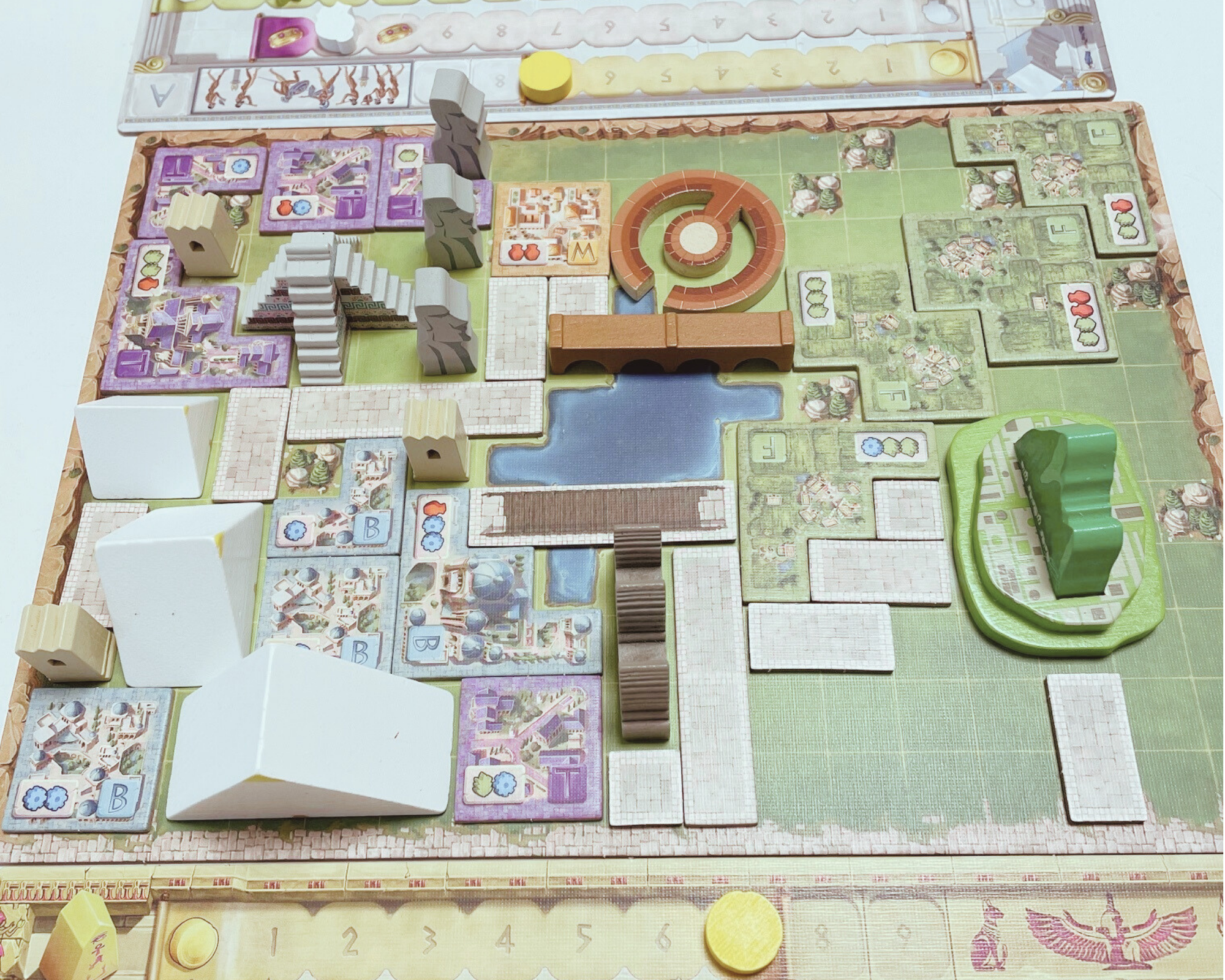
So here’s the truth, spat straight from Jugbite’s maw: World Wonders by Zé Mendes is another one of your human vanity projects where you pay attention to tiny squares and pretend you’re a god because you placed a wooden pyramid on a board. The game makes you sit there, counting your gold like a miser, spending it to buy roads, stacks of short roads, building tiles, towers, or even the precious wooden monuments, and you think that makes you clever. It doesn’t. It makes you a human with nice toys.
You begin each round with seven gold and one miserable action at a time, buying things until your gold is gone and you’re kicked out of the round like a dribbling toddler. If you’re desperate, you can take a loan to push your spending up to nine gold for that round—at the cost of owing a nasty three-gold repayment later or being slapped with a penalty if you never pay. That is human economics: spend now, worry later. When you buy a monument you must throw your remaining gold at it and your round ends, because of course human achievement costs everything at once and also looks dramatic.
Placement rules are the part where cleverness pretends to be skill. Roads must connect to other roads or to the sidewalk or a tower; short roads bought on the same turn can be odd little islands but must still obey adjacency. Buildings need to touch a road or other buildings of the same type, and you can rotate them however you like to squeeze them into your map. Towers must adjoin your stuff and sit on land. Natural resources count as land and can be covered up, though leaving them exposed might net extra points later — which of course gives you that delicious little tension between immediate gain and smug endgame bragging. And the monuments? They’re wooden, not cardboard—real splinters to fawn over, which makes people hold them up like trophies while Krizbella squeals and claps like a daft weasel when she claims one. She’s so proud she practically wears it as a hat; if I catch her wearing the Mausoleum as a bonnet, I’ll make termites look like personal gifts.
There’s an ugly rhythm to the thing: each player spends gold on expensive bits until the coins run dry, tiles that weren’t bought are discarded and replaced for the next round, roads are returned according to player count, and pedestals for turn order get shoved around like status symbols. Turn order itself gets recalculated: if someone bought the first or second player pedestal they sit at the front; otherwise people are ordered by population, then by monuments if tied, then by where they were before. It’s petty, it’s precise, and it rewards the greedy who grab the pedestal or the lucky who keep fewer monuments at the right time to squeak forward. Human politics in a box.
The city growth bit is sneaky: every time you buy a building or a monument you immediately increase your production for Food, Ceramics, or Gears by moving resource markers along your track, and when those markers pass a little population symbol, your population ticks up. Reach the final population space and the game ends at the end of that round — everyone’s sprinting for population like a mob chasing a fresh roast. The game also ends if ten rounds finish and there are no more building tiles to reveal. Scoring is a mixed buffet designed to make humans argue: population rings, the least-produced resource gets points (so being stingy has its perverse reward), monuments score, natural resources can reward you if you didn’t cover them, and city districts — buildings completely surrounded — give more points. You juggle, you plan, you despair when Krizbella sneaks the last building to complete her district because she’s somehow always there with a perfect little smug grin.
It’s tidy and brisk — the turns move and the rules don’t tangle into the kind of thicket that makes me want to gnaw the table. There’s genuine satisfaction in sliding a wooden wonder into place, feeling the weight of it, hearing the little clack as tiles interlock. The components are nice: proper wooden monuments instead of flimsy cardboard, thick tiles, readable boards. It looks good on a shelf and even nicer when your rival squints and curses because they misjudged the rotation and now their map has an ugly gap. That gap is your victory.
But the game has its stings. The market can be a rotten well: if the revealed stacks don’t show what you need, you flounder, and there’s little to do about it but mope. The reliance on spending all your gold each round makes the game less about clever multi-step chains and more about rationing bling; the loan system feels like a bandage for poor planning, and the monuments — though wooden and satisfying — give a theatrical finale that can feel like a last-turn fireworks show rather than a reward for careful play. People who overthink will slow the table; people who rush will sometimes stumble into victory; randomness in what tiles appear can steal a good plan faster than Krizbella can fake a sob story about “misfortune.”
And Krizbella — oh, Krizbella. She parades around claiming monuments and whispering that her palace will “change the game.” She pats her wooden Colossus like it owes her gold. Yesterday she bought the Mausoleum and held it high while telling me it was “poetic.” I want to feed her to the road tiles for poetry. She claims every minor tactical victory as a masterstroke and blames the dice when things go wrong, which is dishonest and also boring. If she thinks a wooden monument makes her wise, let her wear it out in the rain and see if the paint survives. I’ll be waiting with a sack of termites and the patience of a goblin who’s seen empires fall for less.
Final Verdict
So what’s the verdict from a goblin with splinters in his beard? World Wonders is a pleasant, quick city-builder that scratches the itch for tile-fitting and tactical placement without demanding you move into a hermit cave to learn it. It’s not revolutionary, but it’s satisfying, tactile, and mean enough to make games of rookie humans fun to watch. Put it on your table when you want building without a lecture, and bring a pair of gloves for Krizbella so she doesn’t eat the monuments.
Jugbite’s Rating: 7 Cabbages out of 10
And that’s that — a decent little pile of tiles and wood blocks that’ll keep you humans busy squinting at grids while I raid your pantry. Play it, enjoy it, argue over it… just don’t expect me to clap when Krizbella waves her wooden pyramids around like she’s queen of the world.
 Krizbella