
Zoo Management? More Like Zoo Misery!
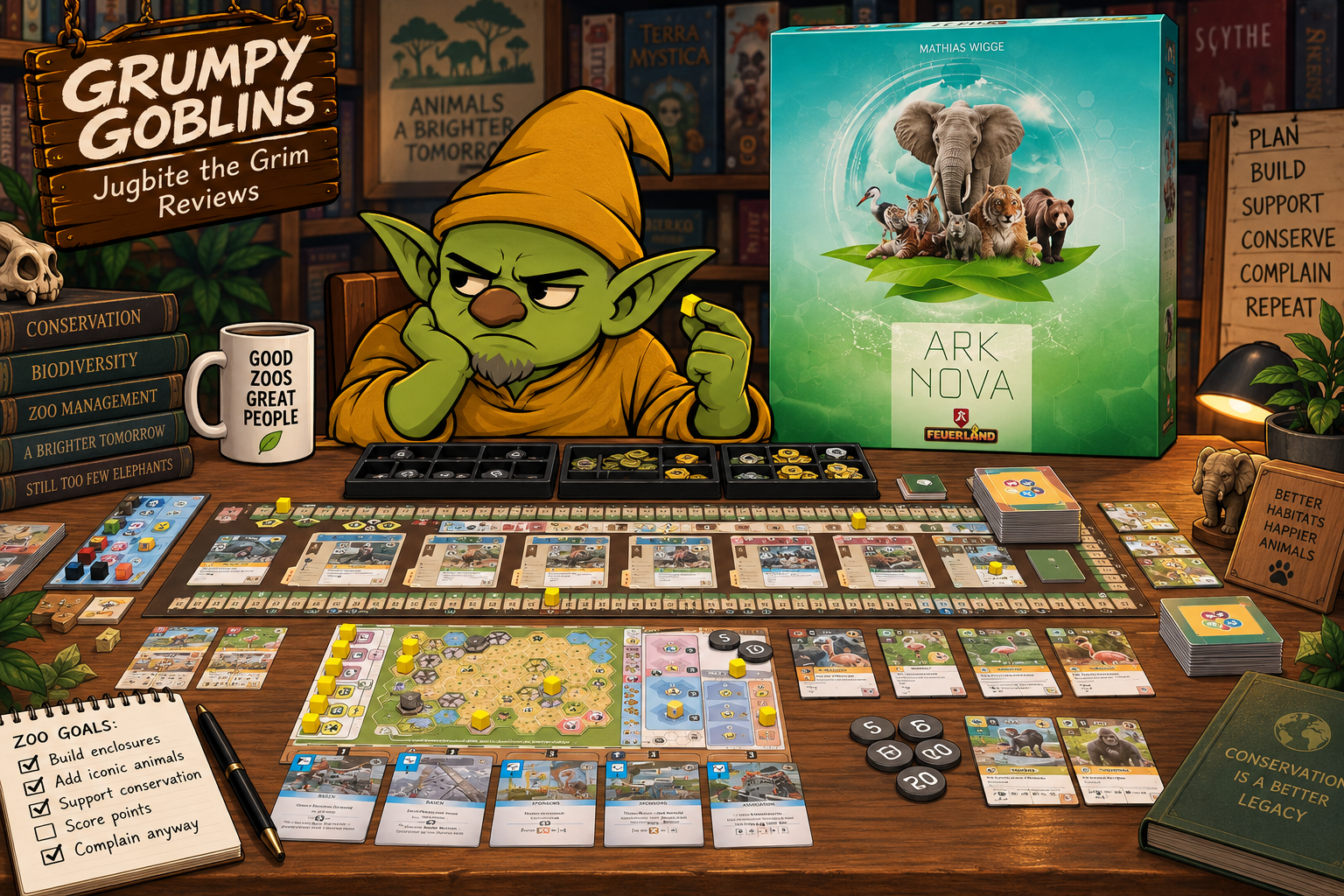
Another sprawling mess of cardboard where humans get to pretend they’re saving the world one sad giraffe at a time. That’s Ark Nova. You sit there clutching your cards, fiddling with hand management, covering up spaces and plopping down enclosures, all while convincing yourself you’re building something meaningful.
It’s a zoo.
You’re building a zoo.
Humans really will turn anything into a strategy game.
Still, I’ll admit the cursed thing has its teeth.
Building a Zoo, Apparently
The basic idea is simple enough. You build your own zoo by placing enclosures and other facilities onto your board, then fill the thing with animals and attractions. The problem, as usual, is that humans have decided that fitting oddly sized bits of cardboard onto a limited zoo map should require actual planning.
Every turn is another attempt to squeeze another bloody enclosure onto your board without wasting space.
The tile placement reeks of desperation.
You trapped a drawing of a panda in an enclosure. Congratulations. You’re practically a conservation hero.
Except the placement actually matters.
Your zoo has limited space, and the shape and size of the pieces you place affects how efficiently you can use that space. You need to think about where things go rather than simply dropping them wherever there happens to be room. Build carelessly and you can make future construction more awkward.
Goblins don’t celebrate efficient zoo layouts; we tear holes in the ground and let beasts roam free.
But apparently humans need a carefully arranged cardboard zoo before they can feel accomplished.
Cards, Actions and Conservation Nonsense
Then there are the cards.
Lots of cards.
Animal cards. Sponsors. Projects. Various bits of human cardboard that you clutch in your hand while trying to work out which one is worth playing and when.
The hand management is one of the things that makes Ark Nova more interesting than its zoo theme deserves. You are not simply collecting animals because they look cute. You have to decide which cards are useful now, which ones are worth keeping and how they fit into the rest of your plans.
And the action system is where things get particularly clever.
You have a row of action cards, and their position determines how powerful those actions are. Use one and it moves back down the row while the others move closer to the front. That means you cannot simply hammer the same useful action every turn at full strength. You have to work with what is available and plan around where your actions will be when you need them.
Humans call this efficiency.
Goblins call it moving the good button closer to your finger.
But it works.
You might desperately want to play an animal card, only to find that the action you need is sitting in an inconvenient position. You can wait, use another action, or change your plans entirely. That creates a surprisingly satisfying rhythm where you are constantly looking not only at what you can do now, but what you are setting yourself up to do next.
Which is annoying.
Because now I have to admit the humans did something clever.
The Animals Are Not the Whole Game
The animal cards may be the obvious attraction, but the zoo is not simply a collection of cardboard creatures.
Your animals need suitable enclosures, and building those enclosures takes space and planning. Larger animals require more room, while other cards and effects create additional considerations for how you develop your zoo.
This means your hand and your board are constantly arguing with each other.
You have a card you want.
You need an enclosure for it.
You need space for the enclosure.
You need the right action to build it.
And by the time everything lines up, somebody has probably done something irritating.
This is where Ark Nova starts feeling less like “build a zoo” and more like a puzzle about getting several systems to cooperate. You are managing cards, space, money and actions at the same time, and improving one part of the zoo can create new problems somewhere else.
A magnificent demonstration of why humans should never be allowed to organize anything without a spreadsheet.
Conservation and the Self-Righteous Human
The conservation projects? Bah! Nothing but points on a track, dressed up as saving the world.
You work on conservation projects while developing your zoo, giving you another route toward your overall goal. The game wants you to care about more than simply filling the board with animals, so conservation becomes one of the things you need to balance against everything else you are doing.
And yes, it fits the theme.
I hate that too.
The conservation side gives you another reason to plan ahead rather than simply stuffing your zoo full of expensive animals. You need to consider which projects are worth pursuing and how they interact with the cards and development choices available to you.
So there you are, carefully balancing your zoo development with conservation projects while pretending that the entire operation is about helping animals.
The wetlands are still full of trash, and you’re still a self-righteous fool.
At least you’re a self-righteous fool with a plan.
Reputation, Money and Other Human Problems
Then there’s the rest of the zoo management.
You need money to build and develop things. You need the right cards. You need the right actions at the right time. Reputation can give you access to cards that would otherwise be out of reach, while your progress in different areas determines what you can accomplish as the game develops.
It all creates a constant balancing act.
Spend too much and you may not have enough for something you need later. Concentrate too heavily on one part of the zoo and another part starts falling behind. Hold onto cards for too long and your hand becomes a collection of things you desperately wanted three turns ago.
Humans apparently call this strategic planning.
I call it making a simple trip to the zoo unnecessarily complicated.
But that complication has a purpose.
Ark Nova gives you enough competing priorities that there usually isn’t an obvious perfect move. You have to decide what matters most right now and what can wait. Sometimes the best move is not the one that gives you the biggest immediate reward, but the one that sets up a stronger combination later.
That is good design.
I resent having to say that.
A Zoo Full of Decisions
This is where Ark Nova earns its reputation as a serious strategy game.
It is not simply about collecting animals and covering your board with enclosures. The cards, action system, zoo layout, money, reputation and conservation goals all pull against each other.
You are constantly trying to make one thing work with another.
And when it does work, it feels good.
You line up the right action. You have the right card. You have the space. You can afford the enclosure. Suddenly the whole stupid machine clicks together and you get exactly what you wanted.
Then you look at your zoo and realize you’ve spent half the game arranging cardboard so a drawing of a panda can live next to a drawing of another animal.
Still, I’ll admit it.
That is satisfying.
The tile placement gives you a spatial puzzle, the cards give you plenty of opportunities to build combinations, and the action system keeps you from simply repeating your strongest move over and over. The conservation and reputation systems give you longer-term considerations while the zoo itself keeps demanding immediate attention.
It’s bloated, yes, but not rotten.
By the time a game ends, your brain feels like it’s been stomped flat by an elephant.
A strategic elephant.
But an elephant.
Final Verdict
Ark Nova is one of those games that makes me want to complain about it for several hours and then immediately start explaining why its systems actually work.
It’s a sprawling zoo-building puzzle where hand management, action selection, tile placement, conservation and reputation all compete for your attention. There is plenty to keep track of, and the game certainly isn’t interested in making every decision easy.
But that complexity has substance.
The action system is clever, the cards give you plenty of possibilities, the zoo board creates a satisfying spatial puzzle, and the conservation projects give you another reason to think beyond simply collecting animals.
The theme may involve humans prancing around pretending they are responsible guardians of nature, but underneath all the pandas and tulips is a genuinely meaty strategy game.
So yes, Ark Nova is complicated.
Yes, it is bloated.
Yes, the whole thing is basically humans building a cardboard zoo and congratulating themselves for it.
And yes, I enjoyed it.
There. I said it.
Jugbite’s Rating: 8.5 cabbages out of 10.
Build your zoo, save your animals, fill your map with enclosures and pretend you’re changing the world.
I’ll be over here, trying to figure out why Krizbella keeps putting the elephants where the monkeys are supposed to go.
Sneer.
 Krizbella