

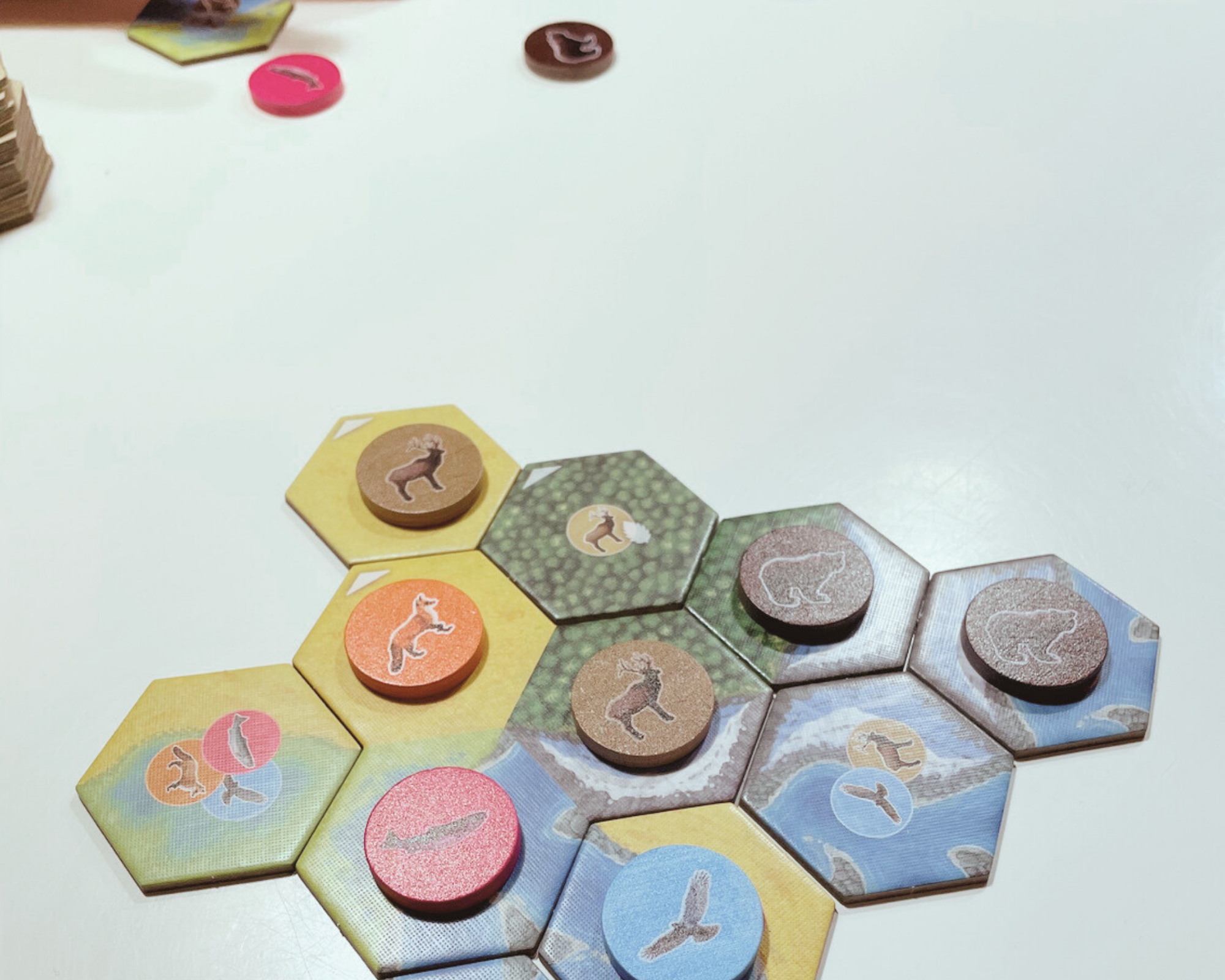
Oh look. Another human board game about “harmony.” About “ecosystems.” About “coexisting.”
DISGUSTING.
Cascadia by Randy Flynn pretends to be this calm, misty-eyed nature stroll through the Pacific Northwest. Watercolor elk. Peaceful salmon. Whispering forests. It looks like something you’d frame above a scented candle.
But don’t let the soft art fool your fragile mammal brain.
This is a cold, ruthless pattern building, tile placement knife fight in a mossy sweater.
And I smells blood under the pine needles.
First, the structure. On your turn, you draft one Habitat Tile and one Wildlife Token as a pair from four available combinations. You don’t split them unless you spend a precious Nature Token. You take what’s there. You adapt. You survive.
Unless the wildlife overpopulates. If all four tokens are the same? Wiped automatically. Three of a kind? You may wipe them once. ONE time. No endless fish-flipping because you “don’t vibe with salmon.” The rules are clear. The forest is not your therapist.
Each player gets exactly 20 turns. No more. No less. When the Habitat Tiles run out, that’s it. Count your points and cry quietly into your reusable water bottle.
The Tile Placement: “Serene” My Wart-Covered Foot
You must place each Habitat Tile adjacent to your existing environment. No sliding. No stacking. No “oopsie forest redesign.” Once that mountain touches that prairie, it’s married.
Matching terrain is not required for placement. But at the end? You score one point per tile in your largest contiguous corridor of each habitat type—Mountains, Forests, Prairies, Wetlands, Rivers.
So yes, you can slap tiles anywhere.
And yes, you will regret it.
In 3–4 players, the largest corridor of each habitat gets 3 bonus points, second gets 1. So while you’re pretending to build a “balanced ecosystem,” you’re actually in a biome arms race.
“Look at my wetlands!”
“Yes, Krizbella, they’re large. We see them.”
Wildlife: Cute Faces, Brutal Demands
Each tile shows which animals it can support. One wildlife token per tile. It must match one of the printed icons. No icon? No animal. Back to the bag with it.
Nature is strict.
Now the scoring cards. Every game uses one randomly selected scoring card for each of the five animals. And these cards are NOT forgiving.
Bears demand exact group sizes. Sometimes they can’t even touch other bear groups. Elk often want precise shapes or straight lines. Salmon form “runs” — each salmon touching no more than two others, and no extra salmon hanging off the side like an awkward cousin. Hawks want isolation or clean lines of sight. Foxes score based on what’s adjacent — diversity, pairs, patterns.
So while you’re placing adorable critters, your brain is screaming:
“IS THIS A LEGAL SALMON RUN OR HAVE I CREATED A FISH ABOMINATION?!”
This is not fluffy. This is spatial math in a flannel shirt.
Nature Tokens: Pinecone Corruption
Keystone tiles reward you with Nature Tokens when you place the matching animal on them. These tokens let you break the pairing rule—take any tile with any token, or wipe tokens from the display.
There’s no limit to how many you can spend in a turn. And each unused one is worth 1 point at the end.
So yes, hoarding pinecones is valid strategy.
You humans love your little resource piles. “Look at my efficiency.” Disgusting.
The Environmental Theme (Suspiciously Well Done)
I hate admitting this.
But the theme works.
Animals want specific arrangements. Habitats reward large connected ecosystems. The mechanics reinforce the idea of environmental balance. It feels cohesive.
It doesn’t feel pasted on like Krizbella’s “Unicorn Tax Audit” prototype, where rainbows scored for adjacency to paperwork.
Cascadia’s theme and mechanics actually align.
Infuriating.
The Real Goblin Take
Cascadia is elegant. Clean. Ruthlessly efficient.
It has almost no rules overhead, yet every single turn matters. Every tile placement tightens the noose. Every wildlife token is a puzzle piece that might explode your future plans.
It plays smoothly from 1–4 players. It doesn’t overstay its welcome. It ends at exactly 20 turns per player. No bloated nonsense. No filler.
It’s the kind of game that looks gentle and plays sharp.
Which is the worst kind of trick.
Final Verdict
Cascadia is what happens when humans disguise a brain-burning optimization puzzle as a peaceful hike.
It is accessible but not simple.
It is relaxing but not soft.
It is friendly but not forgiving.
And if you lose because you built a five-tile prairie that blocked your salmon corridor?
That’s on you, leaf-brain.
Jugbite’s Rating: 8 cabbages out of 10.
Now go hug a tree and calculate adjacency bonuses, you woodland spreadsheet enthusiasts. Jugbite will be in the wetlands, counting fox neighbors like a proper swamp intellectual.
 Krizbella