


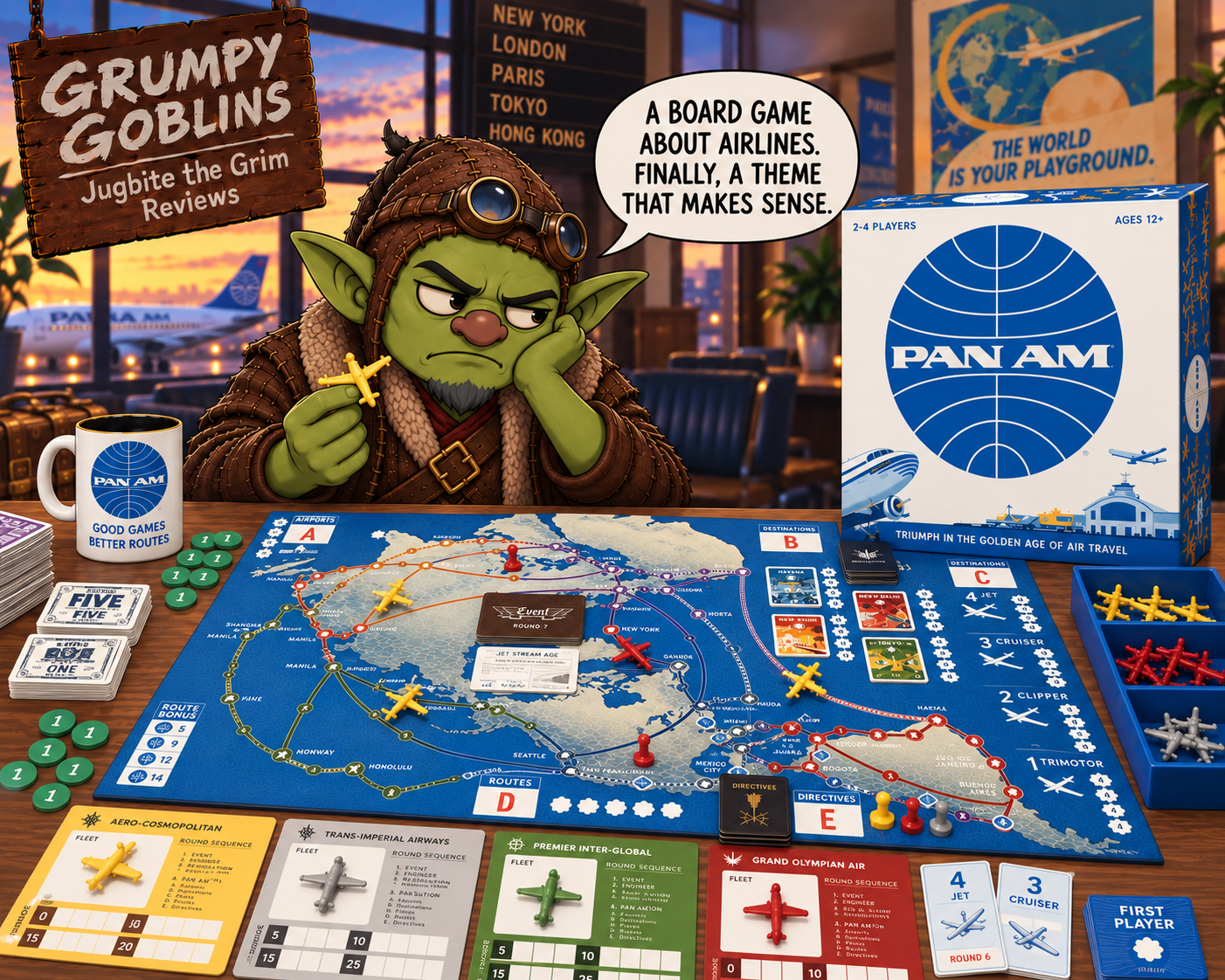
“Pan Am? More like Pan ‘Awful’ — but I’ll admit it’s clever.”
Listen here, you shiny-faced humans. Pan Am is a board game about building airlines, buying routes, competing for airports and planes, and eventually selling your hard-earned routes to Pan Am. Sounds fun, right? Well, if by “fun” you mean watching your hard work get swallowed up by a giant corporation while you’re left counting your coins and questioning your life choices, then sure, have at it.
You start with a small airline and a handful of planes. Your job is to expand across the map by connecting cities and building routes, while competing with the other players for the resources you need to keep growing. The whole thing takes place over seven rounds, with each round bringing events, new opportunities and, inevitably, somebody getting in your way.
And yes, there is money involved. Obviously. Humans discovered long ago that putting money on a table makes otherwise reasonable people behave strangely.
Building Your Airline
The heart of Pan Am is expansion. You want to connect cities, claim routes and improve your airline with better aircraft and access to useful airports.
You start with these little planes, pathetic things barely able to carry a sack of goblin teeth across a pond. As your airline grows, you can acquire aircraft with longer range and reach further across the map. That means your expansion is not simply a matter of grabbing whatever route happens to be available. You have to think about where you want to go and what you need to get there.
And naturally, everyone else wants the same useful things.
Pan Am uses a worker placement system where your engineers are assigned to different areas to pursue the things your airline needs. Airports, routes, planes and other opportunities all compete for your attention, which means every engineer you place is one you are not using somewhere else.
This is where the game starts becoming considerably more interesting than its cheerful little aeroplane theme might suggest.
The Bidding Is Where Things Get Interesting
Oh, and the bidding. The bidding!
Every round becomes a scrum for useful positions, airports, engineers and better planes. I bid 4 coins on Havana, thinking I’d secured it, but then Krizbella, curse her green hide, outbid me by 2, and I had to settle for some backwater airstrip where the passengers are all goats.
That particular incident may have been entirely reasonable.
Probably.
The important thing is that Pan Am makes money matter. Spending too much now can leave you struggling later, but being too cautious means someone else can take the thing you needed. The best move is not always the move that gives you the most immediately. Sometimes you need to spend money simply to stop another player from getting something useful.
A truly delightful little piece of cardboard cruelty.
Selling Your Routes to Pan Am
This is the part that gives Pan Am its identity.
You are spending the game building an airline empire, but Pan Am is steadily expanding as well. Eventually, your routes can be sold to Pan Am, turning the work you invested in building them into money that you can use elsewhere. You can then invest that money into further growth or buy Pan Am stock.
So yes, you are building something only to potentially sell it off.
That sounds completely backwards until you realise that this is the clever part.
Your airline is not necessarily something you are trying to preserve forever. Sometimes the smartest decision is to build a valuable route, sell it at the right moment and turn that money into something more useful. Pan Am therefore becomes less about simply making the biggest airline and more about knowing when to build, when to sell and when to hold your money.
The stock market adds another layer to this. Stock values change during the game, and the timing of your purchases and sales matters. Get it right and you can turn your profits into a much larger pile of wealth. Get it wrong and you have spent your money on pieces of paper while somebody else is counting their winnings.
What am I supposed to do with a slip of paper that says I own a piece of the sky? Can’t eat it. Can’t club a rival with it.
Apparently humans call this investing.
Clever, But Not Exactly Gentle
Don’t get me wrong. Pan Am is clever.
The stock value changes, timing your sales is tricky, and there is a cruel joy in buying up what your friends need. The game rewards planning, but it also forces you to pay attention to what everyone else is doing.
That last part matters.
You cannot simply build your own little airline empire in isolation while ignoring the other players. If somebody is clearly trying to grab something you need, you may have to react. If somebody is sitting on a route you want, you need to work around them. And if another player has just spent a pile of money, you need to ask yourself whether that leaves them vulnerable somewhere else.
That interaction is where much of the fun comes from.
Of course, it also means that if you are not careful, you can spend the whole game with dust in your pockets while the winner cackles with a mountain of shares.
I have seen better financial planning from goblins trying to divide stolen cheese.
Is Pan Am Worth Playing?
So yes, play Pan Am if you like cunning plans, economic brinkmanship, route building and watching your carefully constructed empire gradually get swallowed by the iron wings of capitalism.
It is not simply an airline game where you move little planes around a map and pretend to be important. The combination of route building, bidding, worker placement and the stock market gives you several competing things to worry about, and the most interesting decisions often come from deciding which opportunity you are willing to sacrifice for another.
It is also a game where timing matters. Build too slowly and someone else gets there first. Spend too freely and you may find yourself broke. Hold onto your routes forever and you may miss the opportunity to cash them in. Sell at the right moment and suddenly that route you worked so hard to build becomes the money you need for the next stage of your plan.
That is a good system.
Annoying, but good.
So yes, Pan Am is clever. It gives you meaningful decisions, plenty of opportunities to interfere with your opponents, and a pleasing amount of economic skulduggery without drowning the whole thing in unnecessary complexity.
Just don’t invite me.
I’ve got better things to do.
Like polishing my rock collection.
Jugbite’s Rating: 6.5 cabbages out of 10.
Would play again only if bribed with goblin ale.
 Krizbella